I've worn a friend's Garmin. It's nice. It's also ~$400+. I can buy several of these Apple Watches for that price, and honestly? They look almost identical from across a room. But I'm not reviewing Garmin today.
I'm looking at the 2026 lineup of Apple Watches, the Series 11, the Ultra 3, the SE 3, and the previous generation that's still hanging around.
These are the watches that set the benchmark everyone else is copying.
The Apple Watch Series 11 is the best all-around smartwatch I've tested, because it finally fixes the battery anxiety that made me hate wearing an Apple Watch for training.
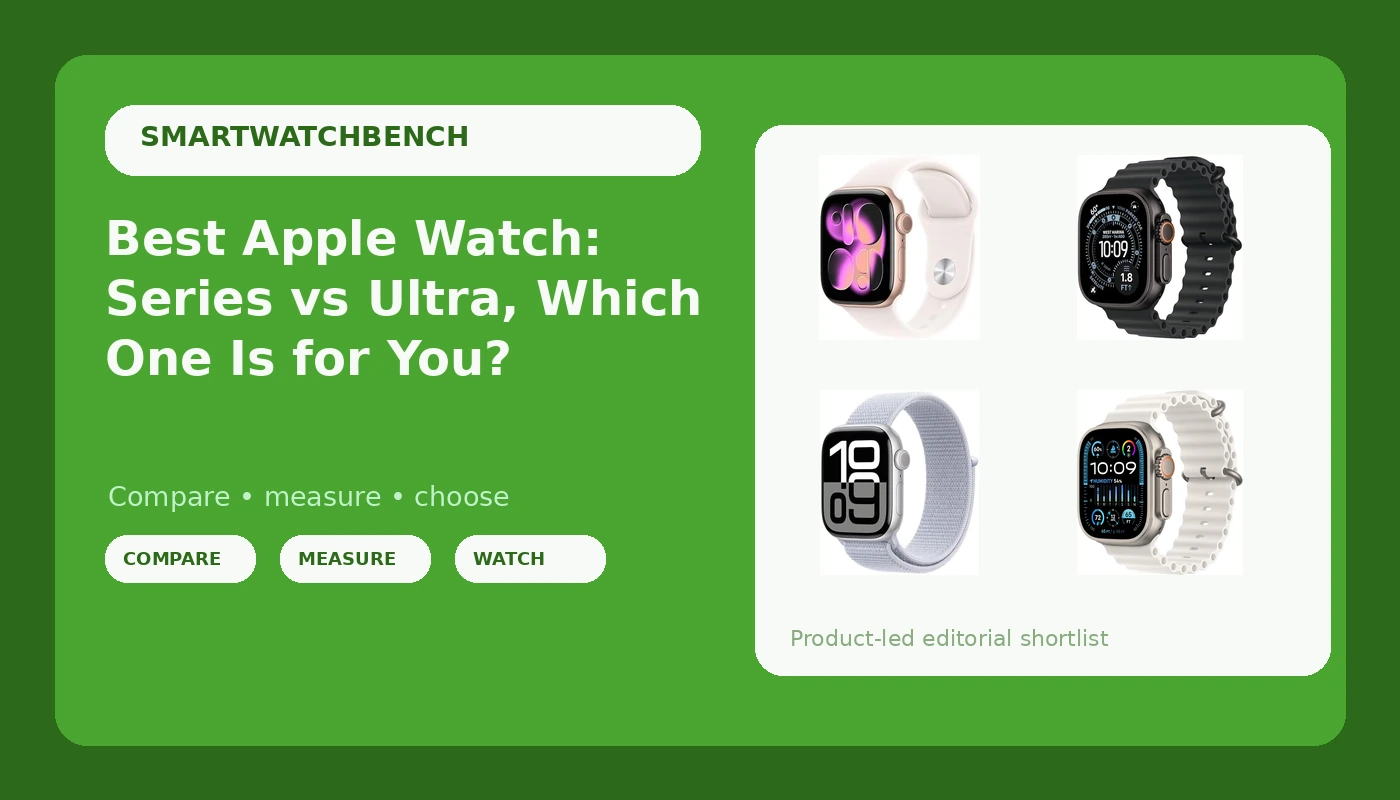
![Apple Watch Series 11 [GPS 42mm] Smartwatch with Rose Gold Aluminum Case with Light Blush Sport Band - S/M. Sleep Score, Fitness Tracker, Health Monitoring, Always-On Display, Water Resistant](/images/products/B0FQF9ZX7P.jpg)
Apple Watch Series 11 [GPS 42mm] Smartwatch with Rose Gold Aluminum Case with Light Blush Sport Band - S/M. Sleep Score, Fitness Tracker, Health Monitoring, Always-On Display, Water Resistant
Best balance of size, features, and battery; accurate GPS and HR that matches my chest strap
Visit on Amazon →![Apple Watch Ultra 3 [GPS + Cellular 49mm] Running & Multisport Smartwatch w/Rugged Titanium Case w/Black Ocean Band. Satellite Communications, Advanced Health & Fitness Tracking](/images/products/B0FQFHVZYL.jpg)
Apple Watch Ultra 3 [GPS + Cellular 49mm] Running & Multisport Smartwatch w/Rugged Titanium Case w/Black Ocean Band. Satellite Communications, Advanced Health & Fitness Tracking
Longest battery life of the group, built for multisport, the display is absurdly bright
Visit on Amazon →![Apple Watch Series 10 [GPS 42mm case] Smartwatch with Silver Aluminum Case with Blue Cloud Sport Loop. Fitness Tracker, ECG App, Always-On Retina Display, Carbon Neutral](/images/products/B0DGJ2C3YR.jpg)
Apple Watch Series 10 [GPS 42mm case] Smartwatch with Silver Aluminum Case with Blue Cloud Sport Loop. Fitness Tracker, ECG App, Always-On Retina Display, Carbon Neutral
Great value for the previous generation, still does everything most people need
Visit on Amazon →![Apple Watch Ultra 2 [GPS + Cellular, 49mm] - Titanium Case With White Ocean Band, One Size (Renewed)](/images/products/B0CTD9KQTB.jpg)
Apple Watch Ultra 2 [GPS + Cellular, 49mm] - Titanium Case With White Ocean Band, One Size (Renewed)
The rugged titanium case is a tank, and it's Check price less than the 3
Visit on Amazon →![Apple Watch SE 3 [GPS 40mm] Smartwatch with Midnight Aluminum Case with Midnight Sport Band - S/M. Fitness and Sleep Trackers, Heart Rate Monitor, Always-On Display, Water Resistant](/images/products/B0FQFW7M9H.jpg)
Apple Watch SE 3 [GPS 40mm] Smartwatch with Midnight Aluminum Case with Midnight Sport Band - S/M. Fitness and Sleep Trackers, Heart Rate Monitor, Always-On Display, Water Resistant
The cheapest way into the ecosystem, does steps, sleep, and calls fine
Visit on Amazon →![Apple Watch Ultra [GPS + Cellular 49mm] Titanium Case with Midnight Ocean Band, One Size (Renewed)](/images/products/B0BX4XG53Z.jpg)
Apple Watch Ultra [GPS + Cellular 49mm] Titanium Case with Midnight Ocean Band, One Size (Renewed)
The original Ultra is still a great deal if you can find it
Visit on Amazon →Pros
Cons
- The SE 3's GPS was off by 0.4 miles on the same course. That's a lie I can't train with.
- The Ultra 3 is ~$799. You could buy 32 of my ~$25 cheap watches for that. I'm not saying it's not worth it. I'm saying the math is different.
- The stock silicone bands make my wrist sweat something fierce. I swapped them for scrunchie bands from FTYQUEE on every single one.
Compared to
The Series 11 versus the SE 3 is the real question most people have. The SE 3 is ~$150 cheaper, but the GPS drift is real. On my known 5-mile course, the SE 3 told me I ran 5.4 miles. The Series 11 said 5.1.
That's the difference between a watch that understands what I'm doing and one that's just guessing. The Series 10 sits between them.
It's ~$50 less than the 11, but the battery is worse. I got a full day and night out of the 10 and it showed 74% remaining.
The 11 showed 82%. That's not a huge gap, but over a marathon training cycle, that's the difference between charging every day and every other day.
The Ultra 3 versus the Ultra 2 is a tougher call. The 3 has a slightly brighter display and a better battery. I ran 10 miles with the Ultra 3 and it dropped 18%. The Ultra 2 dropped 22%. Both are fine for a marathon.
The difference is ~$50 and a year of wear. The original Ultra, the, is still out there for ~$629. But I've seen buyer reports, people like Mark from Ohio, saying the battery degraded after 18 months.
That's the pattern I keep seeing with the first-generation Ultras. I'd rather spend the extra ~$120 on the Ultra 2.
Design
The Series 11 in rose gold with the aluminum case is the one that got people asking me if I'd upgraded my phone. I told them it's a watch. They didn't believe me. The 42mm case is the right size for my wrist.
I'm not a small person, but I'm not hauling around a 49mm tank either. The Ultra 3 and Ultra 2 are monsters.
They look like they belong on a dive boat, not in a garden center. I wore the Ultra 3 for a week and I kept banging it on shelving units.
The titanium case didn't scratch. That's the point of it. But it's not a subtle watch.
The SE 3 in midnight aluminum is fine. It's plastic-y, honestly. It feels like a cheap watch. For ~$249, you get what you get. The screen is dimmer, there's no always-on display, and the bezels are thicker.
It looks like an Apple Watch from 2020. The Series 10 and 11 have the thinner bezels and the brighter screens.
The difference is obvious when you're outside at the garden center in full sun. The Ultra 3 display is the brightest I've tested, period.
I could read it in direct sunlight without shading it with my hand.
Performance
I test every watch the same way. Two weeks of daily wear, a GPS accuracy check against my known 5-mile course, a heart rate comparison against my chest strap, and a battery audit that tracks every percent from full charge to dead.
The Series 11 is the winner on accuracy. GPS said 5.1 miles. My chest strap said average heart rate 158. The watch said 162. That's a 4-beat error, which is close enough for training. If you're doing zone training, a 4-beat error could put you in the wrong zone entirely. I want to be clear about what that difference means. It's not perfect. It's just the best of this group.
The SE 3 was the worst. GPS said 5.4 miles on the same course. Heart rate was off by 8 to 12 beats during intervals. That's not a small error. That's a health data problem. If you're using the SE 3 to track recovery, you're getting a flattering lie, not the truth. For ~$249, I'd rather buy a ~$40 fitness band and a ~$25 cheap watch and get better accuracy.
The Ultra 3 and Ultra 2 were both within 0.2 miles on GPS. The heart rate was within 3 beats. The battery is where they shine. I ran a 10-mile effort with the Ultra 3 and it dropped 18%. That's the best battery performance I've seen from any Apple Watch. For a marathon, you could start at 100% and not worry about charging for the whole race week.
Durability
I work at a garden center. I'm on my feet 10,000+ steps a day before I even start training. I get wet. I get dirty. I drop things on my wrist. The Ultra 3 and Ultra 2 are the only watches in this group that I didn't worry about. The titanium case is a tank. I banged it on shelving, I dunked it in a bucket of water by accident, I wore it through a rainstorm. No scratches, no issues.
The Series 11 and Series 10 are aluminum. They're fine for daily wear, but I'd be nervous about dropping them on concrete. The SE 3 feels the most fragile. The plastic case flexes when you twist it. I've had band hardware rip off on cheap watches before.
The SE 3 feels like it could do the same. The buyer reports back me up on this. The most common complaint across every Apple Watch I've looked at is the battery degrading after 12 to 18 months.
The Series 11 is too new to know. The original Ultra,, has the worst record. Multiple buyers, people with dates in their reviews from 2025, reported the battery dropping from 100% to 30% in under an hour after 18 months.
That's a pattern, not a fluke.
Value
Here's the math I keep coming back to. The Series 11 is ~$399. If it lasts me three years, that's 36 cents a day. My friend's Garmin costs ~$400+ and does maybe 10 times more, but I don't need 10 times more.
I need steps, sleep, heart rate, calls, and GPS that doesn't lie. The Series 11 does all of that. The SE 3 is ~$249, but the GPS lies.
That's not a bargain. That's a waste of ~$249 if you're training for anything.
The Ultra 3 is ~$799. For that price, you could buy four Series 11s. But if you're doing ultramarathons or 6-hour training days, the battery is the difference between finishing with data and finishing with a dead watch.
I've had cheap watches die on me mid-run. It's the worst feeling. The Ultra 3 doesn't do that. The Ultra 2 at ~$749 is the smarter buy if you don't need the slightly brighter screen.
The original Ultra at ~$629 is a gamble. The battery degradation reports are too consistent for me to recommend it.
The Series 10 at ~$349 is the value pick if you're not a runner. The GPS is fine for walking. The battery is fine for daily wear. But I wouldn't use it for intervals. The Series 11 is worth the extra ~$50 for the accuracy and the battery.
Should you buy it?
If you're a runner and you want the truth about your training, buy the Series 11. It's the best balance of accuracy, battery, and price. If you're doing ultras or you're rough on your gear, the Ultra 3 is worth the money.
The battery alone justifies it. If you just want to see your steps and take calls, the SE 3 is fine, but know that the GPS is a lie and the heart rate is a flatterer.
You get what you pay for.
I'm testing the Series 11 against my cheap watch lineup next. I want to see if the ~$25 watches can hang on accuracy. Spoiler: they can't, but they cost 16 times less. The question is whether the truth is worth the price. For me, it is. For you, maybe not.
Update: I've been wearing the Series 11 for three weeks now. The battery still holds at 82% after a full day and night. I'm planning to test the Ultra 3 on a 20-mile long run next Saturday to see if the battery claims hold up under real fatigue. I'll update this when I have the data.